
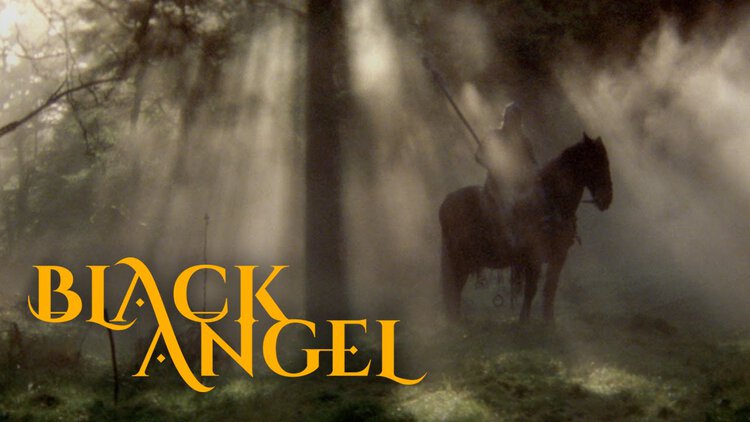
In 1980, some moviegoers arrived for The Empire Strikes Back and first saw a strange 25-minute fantasy about a wounded knight, a mysterious maiden, and a faceless warrior. The short looked like a half-remembered medieval nightmare, yet it was made by someone who had already helped build the Star Wars universe. Then it disappeared for more than three decades. Its return lets us see an overlooked piece of film history beside one of Luke Skywalker’s most unsettling moments.
What Was Black Angel?
Black Angel was the directorial debut of Roger Christian, one of the key artists behind the original Star Wars. Christian had worked as the first film’s set decorator, helping create the worn, repaired, “used future” look that made places such as the Millennium Falcon feel real. That work earned him an Academy Award with production designer John Barry and fellow set decorators Leslie Dilley and Norman Reynolds. His wider career also included art direction on Alien and later second-unit direction on Return of the Jedi and The Phantom Menace.
George Lucas wanted a short film that could be shown with The Empire Strikes Back in selected overseas cinemas. Christian presented his fantasy story, and Lucas commissioned it with a grant of £25,000. Christian took a tiny crew to Scotland with four actors, two trained horses, a Volkswagen bus, a small lighting kit, and a fog machine.
The production was built around its limits. It was filmed in seven days at locations including Eilean Donan Castle, often using natural light because the Highland weather changed too quickly for a conventional setup. Christian and cinematographer Roger Pratt shot in the same wide 2.35 anamorphic format as Empire, so projectionists could run the short before the main feature without changing lenses. They even used unused 35mm film stock from the UK production of The Empire Strikes Back.
The finished short opened with Empire in parts of Europe and Australia, including about 400 cinemas in the United Kingdom. This was not a later bonus feature or a modern fan film. It was an officially commissioned companion film that some audiences saw as part of their original 1980 trip to the cinema.
You Can Watch The Complete Film Here
The restored film is available in full, with a short introduction from Roger Christian. The introduction begins at 0:00, the story starts around 2:11, and the climactic confrontation develops from roughly 20:30 to 25:40.

The story follows Sir Maddox, a knight returning from the Crusades to find that sickness and violence have destroyed the home he knew. His journey moves away from normal geography and into a dreamlike realm. There he meets a maiden trapped under the power of the Black Angel, an armored figure who feels less like an ordinary enemy and more like death given physical form.
Christian was strongly influenced by Andrei Tarkovsky’s use of images, silence, landscape, and time to reach the subconscious. That influence is visible in the film’s slow pace, misty forests, ruined stone, reflective water, and limited dialogue. The plot is simple because the film works mainly through mood and myth. Maddox is not just rescuing someone from a villain, he is moving through grief, temptation, fear, and sacrifice.
The Black Angel’s design is especially effective. The figure is dark, damaged, and almost empty, with no readable human face to soften him. When Maddox finally fights him, the scene feels detached from ordinary time. That quality became the short’s clearest link to The Empire Strikes Back.

The Technique George Lucas Carried Into Empire
In his introduction to the restored film, Christian explains that Lucas liked the way the fights had been “step printed” to slow them down. Lucas then used the same technique in one scene from The Empire Strikes Back.
Step printing is an optical process in which selected frames are repeated during printing. If a frame is held twice or three times, the movement lasts longer on screen without becoming the clean, fluid slow motion created by filming at a high frame rate. The result can look heavy, broken, and slightly unreal. Motion seems to drag while still arriving in small visual pulses.
Editor Alan Strachan recommended the process for Black Angel‘s battle. It stretched the actors’ movements and gave the duel what the restoration team later described as “slowed-down time and heightened reality.” It also helped a small production create an effect that fit the story better than a fast, polished sword fight would have.
Christian’s own wording is slightly more careful. He says Lucas used the technique in “one of the scenes” in Empire, without naming that scene in the YouTube introduction. That distinction matters. The direct, first-person claim establishes the transfer of the technique, while the production history identifies the Dagobah vision as its destination.
The Dagobah Cave Is The Right Comparison
Luke’s encounter in the cave is not a normal lightsaber duel. Yoda warns him that the place is strong with the dark side and tells him he will find only what he takes inside. Luke carries his weapons anyway. A silent Vader appears, Luke attacks, and the vision ends with Vader’s severed helmet revealing Luke’s own face.
The scene is about Luke’s fear of becoming what he hates. It also foreshadows the family truth waiting for him on Cloud City, but it does not explain itself in ordinary dialogue. The official exploration of Luke’s dreamlike experience in the Dagobah cave describes the setting as a journey into his inner self, where the line between reality and false appearance collapses.

That is where the connection to Black Angel becomes clearer. Both scenes place a young or wounded hero in an unnatural landscape. Both present an armored opponent as more than a person. Both use a brief sword confrontation to expose an internal fear. Step printing makes the violence feel symbolic rather than athletic, as if the characters are trapped inside a vision that moves by different rules.
The influence is strongest at the level of technique and mood. There is no solid evidence that the maiden, Maddox, or the Black Angel supplied the plot of Luke’s cave test. There is also no reason to stretch the claim to the faster and more physical Bespin duel. The traceable connection is narrower and more interesting: Lucas saw how Christian made a mythic fight feel suspended in time, then adopted that visual tool for Luke’s own symbolic confrontation.
How A Film Seen By Thousands Vanished
Despite its original theatrical run, Black Angel was never released on VHS or DVD. The film elements were stored through Rank Laboratories in England, and Christian believed the only negative had been destroyed after the company closed. For years, even the director could not show his own first film.
The trail reopened in December 2011, when an archivist at Universal Studios located surviving material in the studio’s library. The exact route into that vault was unclear, although the elements may have moved through Rank’s Los Angeles operation and later entered Universal’s holdings through a vault acquisition.
What survived was a timed interpositive, a film element made after Christian and Pratt had established the original color timing. That proved valuable because it preserved their visual decisions. EFilm cleaned and scanned the material at 4K for archival storage, then supplied 10-bit 2K DPX files for restoration. Athena Studios spent about eight to nine weeks removing dirt, scratches, splice marks, and damage frame by frame. Colorflow then handled grading and finishing while trying to protect the saturated color and shadowy texture of the 1980 version.
The restored Black Angel returned to festival screens, including a sold-out North American premiere at the Mill Valley Film Festival in 2013. It later reached a much larger audience when the complete restored short was released free on YouTube.