
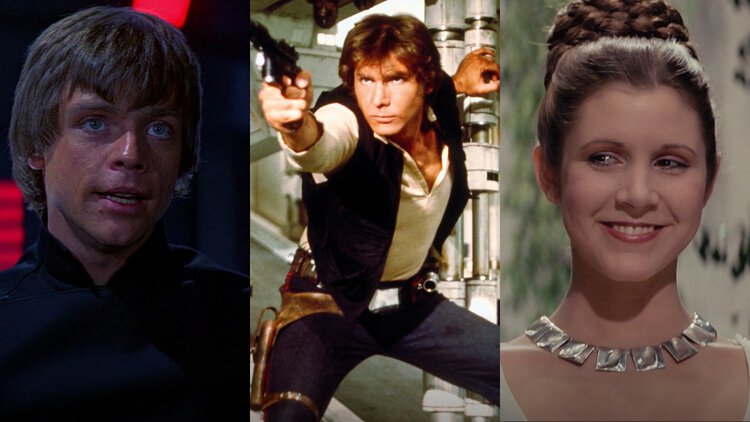
Mark Hamill just gave Star Wars fans one of those quotes that instantly reopens an old wound.
During a Hollywood Reporter actors roundtable, Hamill was asked a rapid-fire question about a living actor he had never worked with and would still like to work with. His answer was not some random dream co-star. It was Harrison Ford — specifically, Harrison Ford in the sequel trilogy.
That is the part that hits. Luke Skywalker, Han Solo, and Leia Organa all returned in Disney’s sequel era, but the movies never gave the original trio one real scene together. Hamill says he actually asked for that moment. Not a whole Luke-centered movie. Not a rewrite that pushed Rey, Finn, Poe, or Kylo Ren off the board. Just a short reunion.
His pitch, in his own words, was basically: aren’t we going to have a moment where all three of us get together and “raise the roof”? It would only take 30 seconds. According to Hamill, J.J. Abrams told him, “Well, Mark, it’s not Luke’s story anymore.”
And honestly? That answer explains a lot about why this still bothers fans. Abrams was not completely wrong about the sequel trilogy needing to belong to a new generation. But Hamill’s point is hard to shake: Star Wars was not Obi-Wan Kenobi’s story either, and Alec Guinness still got to be crucial.
The quote that set fans off again
The key moment comes near the end of The Hollywood Reporter’s roundtable video. Hamill is asked which living actor he has never worked with and would most like to work with. He answers, “Well, in the sequel trilogies, Harrison Ford.”
Then he explains why. Hamill says he only had “two cameos” and that he wanted a moment where Luke, Han, and Leia were all together. He describes the proposed reunion as something that would take “30 seconds.” Then comes the line fans are going to quote forever: Hamill says J.J. Abrams replied, “Well, Mark, it’s not Luke’s story anymore.”

That distinction matters: this is Hamill recounting what he says Abrams told him. It is not a Lucasfilm press release, and it should not be treated like an official statement of sequel trilogy policy. But as a behind-the-scenes explanation from the actor who played Luke Skywalker, it is absolutely worth taking seriously.
What canon actually gave us instead
Canonically, the sequel trilogy does bring back all three original heroes. The problem is the timing. Han and Leia share major scenes in The Force Awakens, while Luke is held back until the final scene on Ahch-To. By the time Luke enters the story in a meaningful way, Han is already dead.
Then The Last Jedi finally gives Luke and Leia a reunion, and it is one of the film’s most emotional legacy moments. But Han is gone. By The Rise of Skywalker, Leia’s role is shaped around unused Carrie Fisher footage after Fisher’s death, and Luke appears as a Force spirit. Again, there is no living trio reunion.

So the fan frustration is not based on a misunderstanding. Luke, Han, and Leia did not all stand together again in the sequel trilogy. Wookieepedia’s pages for the sequel trilogy and the individual sequel films line up with the obvious movie facts: Abrams directed The Force Awakens and The Rise of Skywalker, Rian Johnson directed The Last Jedi, and the story structure separates the original heroes instead of reuniting them as a trio.
The defense of Abrams actually makes sense… to a point
Here is the fair version of Abrams’ side: the sequel trilogy was supposed to pass the torch. If the new movies became “the Luke, Han, and Leia show,” the new characters would instantly feel secondary. Rey’s mystery, Finn’s break from the First Order, Poe’s Resistance role, and Kylo Ren’s fall all needed room to breathe.
That is not a ridiculous concern. One of the hardest things about reviving a beloved franchise is giving audiences what they miss without letting nostalgia eat the new story alive. If Luke shows up too early and starts solving everyone’s problems, Rey’s journey changes. If Han, Leia, and Luke dominate the emotional center, the sequels risk becoming a reunion special instead of a continuation.

And to be fair, The Force Awakens clearly uses Han as the main legacy bridge. Han guides Rey and Finn into the larger myth, confronts Kylo Ren, and gives the movie its biggest gut-punch. Leia anchors the Resistance and carries the emotional history with Han and Ben Solo. Luke is the missing legend everyone is chasing.
So yes, “it’s not Luke’s story anymore” is a defensible creative instinct. The sequels were not meant to simply hand the keys back to the original cast.
But Hamill’s “30 seconds” argument is stronger than people want to admit
The problem is that Hamill was not asking for Luke to become the lead again. He was asking for one scene. Thirty seconds. A breath. A look. A joke. A hug. The kind of tiny legacy moment that tells fans, “Yes, these three people mattered to each other, and the story remembers that.”
That is why his Obi-Wan comparison lands. The original Star Wars was not Obi-Wan’s story. Luke was the young hero. Leia was the rebel leader. Han was the rogue getting pulled into something bigger. But Obi-Wan still shaped the entire movie. He did not need to own the story to matter.
Hamill’s point is not that Luke should have replaced Rey. It is that a legacy character can be crucial without taking over. Alec Guinness did it in 1977. Han basically did it in The Force Awakens. Leia did it across the sequel trilogy as much as real-world circumstances allowed. A short trio scene would not automatically break the passing-the-torch structure.

That is the part fans keep coming back to. A reunion scene could have been emotionally huge without requiring a totally different trilogy. It could have happened as a flashback, a Resistance planning moment before tragedy, a Force-connected vision, or even a brief farewell beat. Some versions would have worked better than others, but the basic idea was not impossible.
Why the missing reunion still stings so much
This is bigger than a cameo complaint. Luke, Han, and Leia are not just three famous faces from the old movies. Their friendship is the emotional spine of the original trilogy. Luke pulls Han toward something more selfless. Leia challenges both of them. Han gives the rebellion its most reluctant hero. Together, they make the galaxy feel worth saving.
That is why fans wanted to see them together as older people, even briefly. Not because the sequels needed to become a victory lap, but because the original trilogy ended with them surviving the Empire together. Then the sequels reveal that everything got complicated: Han and Leia lost Ben, Luke vanished after his Jedi temple failed, and the galaxy slid back into war. That is powerful material, but it is also bleak. One moment of the three of them in the same frame could have softened that blow without erasing it.
Instead, the movies give us fragments. Han and Leia get their heartbreak. Luke and Leia get their goodbye. Han and Ben get their tragedy. Luke and Rey get the mentor conflict. All of those pieces have value. But the original trio never gets one final shared breath.
Hamill’s earlier Star Wars comments make the reunion issue sting even more
What makes the roundtable clip more interesting is that Hamill had just been talking about the original Star Wars with real affection. He remembered being unsure of the tone at first, wondering if the dialogue was meant as a Flash Gordon-style sendup, and getting almost no help from Harrison Ford or George Lucas when he asked how to play it.
His solution was to play it sincerely. That choice mattered. Hamill says that when he finally read the full script, he believed in it because it had fantasy, humor, irony, Princess Leia not acting like a damsel in distress, and the droids arguing like a comedy team. Even without John Williams’ music or the finished effects, he understood that the story worked on multiple levels.
So when the same actor says he wanted one more moment with Ford and Fisher in the sequel era, it does not sound like empty fan service. It sounds like someone who understood the strange emotional chemistry that made the first movie work. Hamill knew those three characters together had a charge that no amount of lore explanation can replace.
Canon, production claim, and fan interpretation — keep them separate
Canon: Luke, Han, and Leia all exist in the sequel era, but the films never reunite them as a living trio on-screen. Han dies in The Force Awakens before Luke properly returns. Luke and Leia reunite in The Last Jedi. Leia’s The Rise of Skywalker role was built around available Carrie Fisher footage after her death.
Production/source claim: The Abrams line should be attributed to Hamill. The accurate phrasing is that Hamill says J.J. Abrams told him it was not Luke’s story anymore. That is different from saying Abrams issued an official public explanation.
Fan interpretation: The strongest reading is that the sequel trilogy chose new-generation focus over legacy-trio closure. Some fans think that was necessary. Others think it was a massive missed opportunity. Both reactions make sense, but neither should be dressed up as canon.
So was Hamill right?
On the big-picture goal, Abrams had a point. The sequel trilogy could not just be Luke’s story again. It needed new heroes, new wounds, and a future beyond the original trio.
But on the specific request? Hamill’s argument is the one that feels more convincing. A 30-second Luke, Han, and Leia reunion would not have stolen the trilogy from Rey. It would not have turned the sequels into a nostalgia museum. If handled carefully, it could have been the emotional bridge fans were waiting for.
That is why this quote is going to keep circulating. It gives fans a simple explanation for something they already felt: the sequels brought the legends back, but never let the three most important ones stand together one last time.
And if Hamill is right that it only needed 30 seconds, that might be the most frustrating part of all.
Sources used for this draft include The Hollywood Reporter roundtable video, StarWars.com Databank pages for Luke Skywalker, Han Solo, and Leia Organa, and Wookieepedia verification for the sequel trilogy and sequel film continuity.