
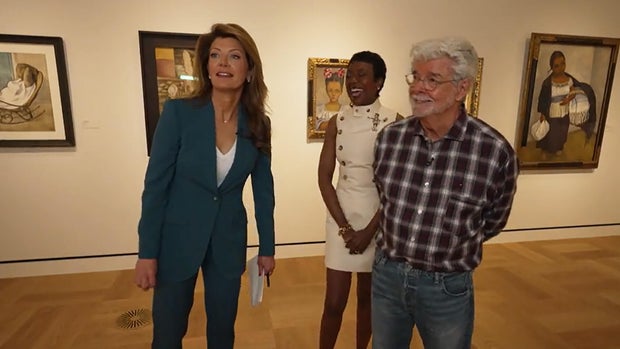
George Lucas has revisited one of the biggest unfinished chapters in Star Wars: the three movies he once intended to make next. The subject came up during a September 20 interview with Norah O’Donnell, alongside his wife and business partner, Mellody Hobson.
“I Had Three More Star Wars to Make”
The remark arrived late in the CBS Sunday Morning extended interview, after Hobson described how closely Lucas had supervised the Lucas Museum of Narrative Art. He had become involved in everything from the building’s exterior to the art on its walls, pushing the team to carry out a vision that was difficult to explain.
Lucas then put the personal cost into plain language: “I decided to retire from making movies, which was a big deal because I had three more Star Wars to make.”
He followed that with the reason that gives the remark its weight: “But I realized that I was running out of time, and I did want to make this museum.”
At 82, Lucas was looking back on a decision about where to put his time, not announcing another trilogy. There was no new production plan, release date, or promise that he would return to directing. The September 22 news coverage brought attention to the line, but the full conversation makes its context clearer: he was explaining why the museum had become such an important commitment.

That also puts a limit on what we can take from it. Lucas did not identify the plots of those three films in this interview. He did not say that finished scripts were waiting to be filmed. For that part of the story, we need to go back to the work happening before Disney took over Lucasfilm.
The Next Trilogy Was Real Work, Not Just a Passing Idea
Lucas had more than a vague wish to keep the saga going. In the official 2012 discussion with Kathleen Kennedy, he stated that he had story treatments for Episodes VII, VIII, and IX. He also said he would not make more films himself, while supporting Kennedy’s plans to continue them.
A treatment is a story outline, not the same thing as a completed screenplay. It can establish characters, major events, and the direction of a film without supplying every scene and line of dialogue. That distinction matters here. Lucas’s trilogy existed in development, but that does not mean three production-ready movies were sitting on a shelf.
There is a useful record of that development inside Lucasfilm. On June 29, 2012, Pablo Hidalgo learned that the company was preparing Episodes VII, VIII, and IX. As Lucas worked on the treatments, Hidalgo received research requests from his office and helped assemble material for the next filmmakers. Those details appeared in Lucasfilm’s contemporary account of the transition, published that October.
The timing also complicates the idea that everything ended immediately after Revenge of the Sith in 2005. That remained Lucas’s last feature as director, but his withdrawal from mainstream filmmaking was a longer process. By May 2012, he was publicly discussing retiring to make smaller, experimental “hobby movies.” Work on the next Star Wars trilogy and plans to hand over the company were part of that same period.

Selling the Stories Did Not Mean Disney Had to Film Them
When the Disney acquisition was announced on October 30, 2012, Lucas described the handover as a way for Star Wars to live beyond him. Kennedy would lead Lucasfilm, and the announcement included plans for Episodes VII, VIII, and IX.
But ownership of Lucas’s story material and a commitment to use it were two different things. In his memoir, The Ride of a Lifetime, Bob Iger explained that Disney bought the three outlines without being contractually required to follow their plots.
Iger also described Lucas’s disappointment when the new team presented a direction that did not use one of the stories he had submitted. In Iger’s account, Lucas had understood the purchase as an indication that his treatments would guide the films, even though the agreement did not require it.
What His Unmade Sequels Might Have Looked Like
Some of Lucas’s proposed story ideas have become public, although they should not be treated as one final, locked shooting script.
In his discussions for Paul Duncan’s The Star Wars Archives: 1999–2005, Lucas described a post-Empire story about rebuilding the Republic and the Jedi. Leia would face the challenge of restoring political order, while Luke would work to rebuild the Jedi. Darth Maul would consolidate power in the criminal underworld, with Darth Talon as his apprentice.
That is an interesting shift in the problem facing the heroes. Defeating an emperor is not the same as making a stable society out of what remains. Criminal groups and surviving armed factions would give Leia something more complicated to confront than a single victory on a battlefield. Meanwhile, Luke’s task would require patience: rebuilding an order means finding and teaching people, not simply winning another duel.
There is a continuity boundary here, too. Darth Talon’s original comic-book history belongs to Legends. A proposed movie role does not make that history current canon, and Lucas’s unused sequel plans are unmade production ideas, not an alternate set of released canon films.
The outline of that story is enough to show a different direction. It is not enough to judge three films that were never completed. Performances, dialogue, pacing, and later revisions would all have shaped the result.
The Museum Was Not a Detour From His Interests
The project Lucas chose opened to the public on September 22, 2026. The Lucas Museum of Narrative Art occupies a 300,000-square-foot building in Los Angeles’s Exposition Park, with more than 1,300 works in its opening exhibitions and over 30 galleries.

Its purpose goes well beyond displaying Star Wars objects. Illustration, comics, paintings, photography, and film material sit within a broader history of telling stories through images. Lucas was blunt about that distinction during the museum tour with CBS: “It’s not a ‘Star Wars’ museum, it’s a narrative art museum. It’s about telling stories.”
That connects directly to his filmmaking. In the extended interview, Lucas recalled wanting to become an illustrator and explained how artists helped him turn imagined characters and worlds into something visible. “I could never have done Star Wars without my illustrators,” he said.